Leveraging Digitization to Decarbonize U.S. Prescribing Information
Aligning U.S. Prescribing Information policy with practice could save 640,000 tonnes CO2e each year.
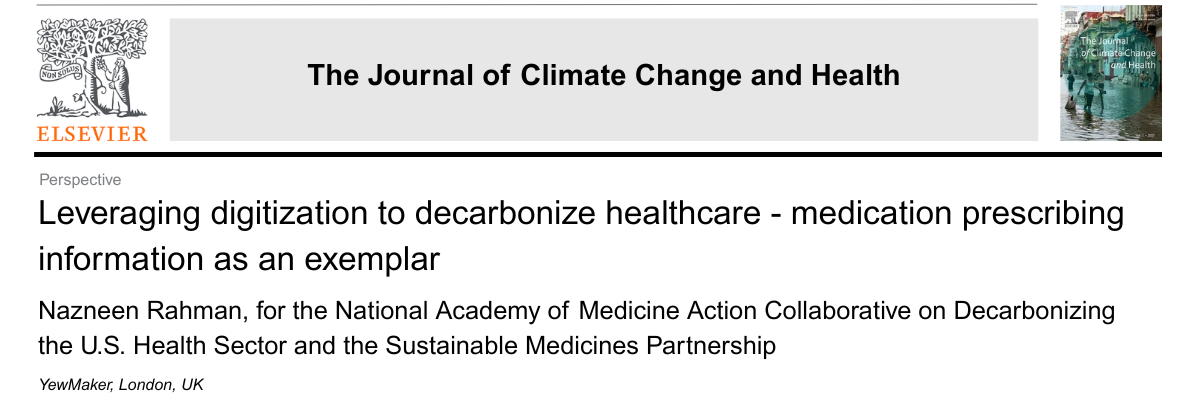
Our Perspective, published in the Journal of Climate Change and Health, outlines the history, challenges, opportunities, and a transition roadmap.
Digital-first Medication Prescribing Information
In every country detailed Prescribing Information (PI), is provided to healthcare professionals about the medicines they prescribe. In most countries this information is submitted, updated, and accessed digitally and printed only if needed.
In the U.S. this digital-first system already operates in practice. The PI is submitted to the FDA electronically, and approved versions are made available online at DailyMed, which is updated daily.
However, the policy in the U.S. remains a dual system: a printed copy of the Prescribing Information must also be provided with every prescription. This printed version is rarely used, and often just thrown away.
Environmental Impact of the Dual System
The outdated U.S. policy has significant negative environmental impacts. In 2022 6.7 billion prescriptions were dispensed. Each one included a printed PI, often running to many pages. This consumes vast resources annually.
🌳 ~ 1.8 million trees
🌍 ~ 640,000 tonnes CO₂e - equivalent to the annual emissions of ~ 128,000 cars 🚗.
The Opportunity
U.S. healthcare professionals already use the digital PI as their primary source. Aligning policy with practice would:
Support clarity and safety with a single, always up-to-date source of information
Eliminate redundant printing
Cut waste and emissions
Bring the U.S. in line with international standards.
This can be achieved without any change in clinical practice.
The Transition Roadmap
The Perspective sets out how the U.S. can safely move from a dual system to digital-first Prescribing Information. The roadmap includes:
Legislative change to remove the mandatory print requirement
Access to printed copies maintained for those who need them
Simplified Patient Medication Information to support patients alongside Prescribing Information
Clear communication and engagement with stakeholders to ensure a smooth transition.
These steps provide a practical path to reduce waste and emissions while ensuring safe, reliable, access to information.
Learn More
Read the full Perspective in The Journal of Climate Change and Health:
Rahman N. Leveraging digitization to decarbonize healthcare – medication prescribing information as an exemplar. The Journal of Climate Change and Health. 2025; 25:100554. https://doi.org/10.1016/j.joclim.2025.100554
This perspective was developed as a collaboration between the National Academy of Medicine Action Collaborative on Decarbonizing the U.S. Health Sector and the Sustainable Medicines Partnership.
“With this Perspective we highlight how aligning U.S. Prescribing Information policy with clinical practice can deliver immediate benefits.
By removing outdated requirements, we can cut waste and emissions, and improve clarity for healthcare professionals and safety for patients.”